Check the details
Source notes for this guide
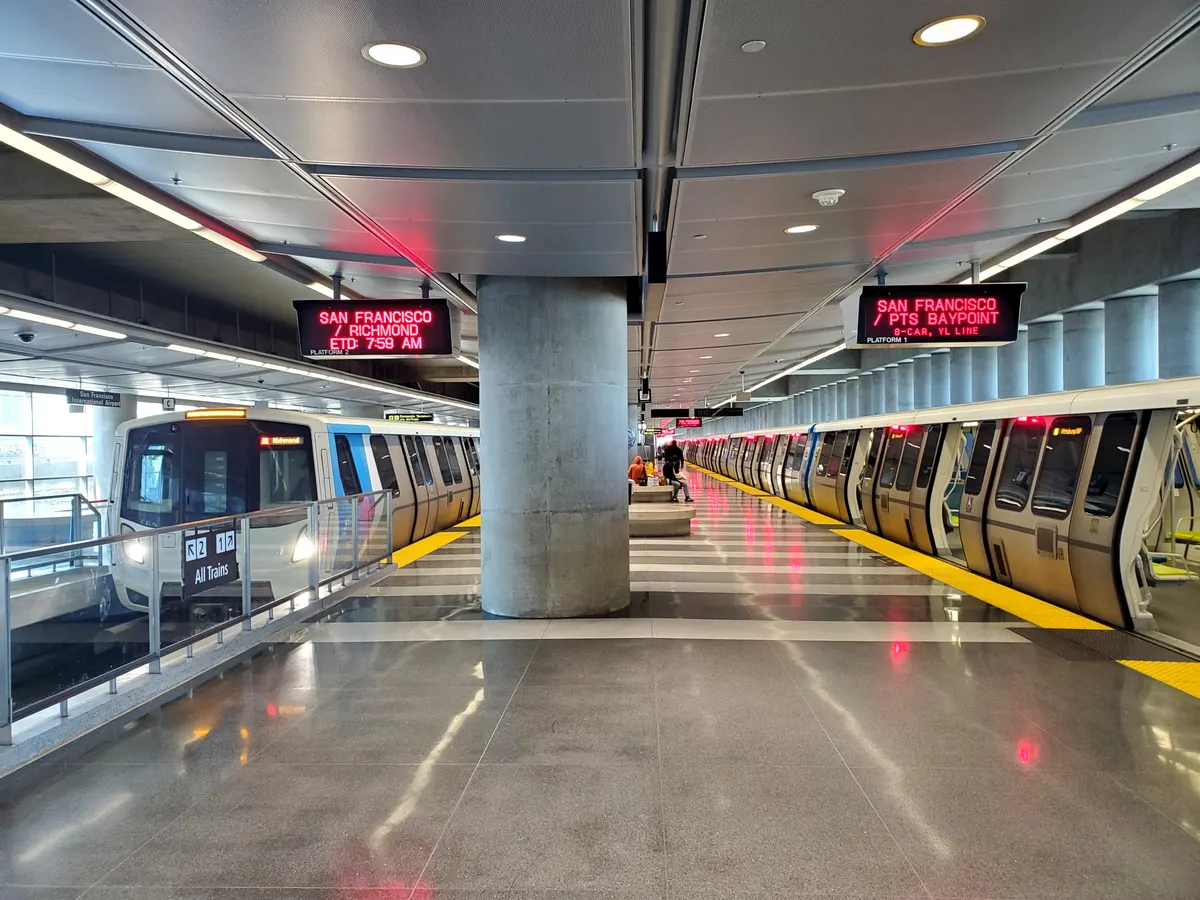
SFO’s BART station is in the International Terminal; the free AirTrain connects airport terminals to the station.
Checked Oct 20, 2026 · Recheck by Oct 27, 2026This detail needs a fresh check before you rely on it. Consult the operator for its current rules.
Bay Area Rapid Transit: Airport Connections (SFO & OAK) ↗The F Market & Wharves stop list includes the Ferry Building, Pier 39 and Fisherman’s Wharf stops. Opposite directions use different stops; this is not a live-service or step-free-access guarantee.
Checked Oct 20, 2026 · Recheck by Oct 27, 2026This detail needs a fresh check before you rely on it. Consult the operator for its current rules.
San Francisco Municipal Transportation Agency: F Market & Wharves ↗
A car-free San Francisco trip is easiest to organize around an arrival route, a useful hotel location and a small number of connected outings. Choose those three things before buying a transit pass. You can use public transport for sightseeing and still choose a taxi for an awkward airport transfer.
Use this guide to decide where to base yourself and how to group your days. The linked guides handle the airport journey, payment choices, pass calculation and bridge visit in more detail.
Choose a hotel by testing the last connection
Use the hotel’s actual entrance address in a journey planner. Test both your airport arrival and the return from the outing you care about most. The district name alone does not tell you how far you will carry bags or where you will change vehicles.
| Accommodation pattern | Journey to investigate | What could change the decision |
|---|---|---|
| An address near a downtown BART station | SFO rail connection, station exit and final walk | A room advertised as near a station may still require a walk you would rather avoid with bags |
| A Fisherman’s Wharf address | BART followed by a waterfront connection or a road transfer | Count the street-level transfer and the walk from the last stop |
| An address outside those corridors | The complete route to the entrance, including any bus or car leg | A lower room rate may come with journeys you repeat every day |
BART’s airport guide is a starting point for the rail portion. Compare accommodation using room cost + expected local transport + arrival and departure transfers, rather than room price alone. Add your own limits on transfers and walking; a slightly longer direct journey may suit your group better than a shorter itinerary with more changes.
Give each day one transport backbone
Choose a main destination, a nearby optional stop and a way back to the hotel. This creates an outing you can shorten without having to redesign the whole day.
| Day idea | Main planning decision | Keep optional |
|---|---|---|
| Waterfront | Use the F Market & Wharves stop list to connect the Ferry Building corridor with a chosen waterfront stop | Another stop along the same corridor |
| Golden Gate Bridge | Choose a south-end visit, a partial walk or a crossing before selecting transport | A further destination after the bridge |
| Another neighborhood | Plan the journey to one specific attraction or entrance | A second nearby visit that does not require another cross-city transfer |
The bridge is a separate routing problem: the official visitor guide distinguishes its two ends. Do not add a full crossing to an already crowded day without planning the return. Our bridge guide compares those choices.
Buy tickets after drawing the route
Write down the operator for each leg. BART, Muni and Golden Gate Transit have different services and products. A shared payment method does not turn them into one unlimited ticket.
Start with BART, Muni and Clipper explained, then mark ordinary Muni journeys, cable cars and other operators separately. Check a product’s coverage against SFMTA’s fare overview before buying. The Muni pass comparison helps count paid fare windows instead of charging your budget for every boarding.
Separate arrival day from sightseeing day
On arrival, the objective is to reach the accommodation with your group and bags. Compare the complete SFO-to-Wharf transfer with a direct road option if that is where you are staying. Do not choose a difficult transfer solely to make the whole trip qualify as car-free.
Before departure, save the hotel entrance, the expected arrival route and an alternative. Recheck service for the time you expect to leave the terminal after baggage collection. For each sightseeing day, save the return journey before setting out and drop an optional stop if weather or energy changes the plan.
The aim is a repeatable planning method: a base with manageable connections, one connected outing at a time and tickets that match the services you will actually use. Any accessibility requirement needs checking across the whole journey, including the exact stops and approach paths, rather than assuming a route is suitable from its name.
Go to the source
Official references
- Airport Connections (SFO & OAK) ↗Bay Area Rapid Transit · Checked Oct 20, 2026
- Fares ↗San Francisco Municipal Transportation Agency · Checked Oct 20, 2026
- F Market & Wharves ↗San Francisco Municipal Transportation Agency · Checked Oct 20, 2026
- Public Transit - Visiting the Bridge ↗Golden Gate Bridge, Highway and Transportation District · Checked Oct 20, 2026
This guide is research based, rather than a claim of firsthand testing. Read our editorial method or report a correction.